
Getting down to brass tacks
When a publisher asks the hard questions

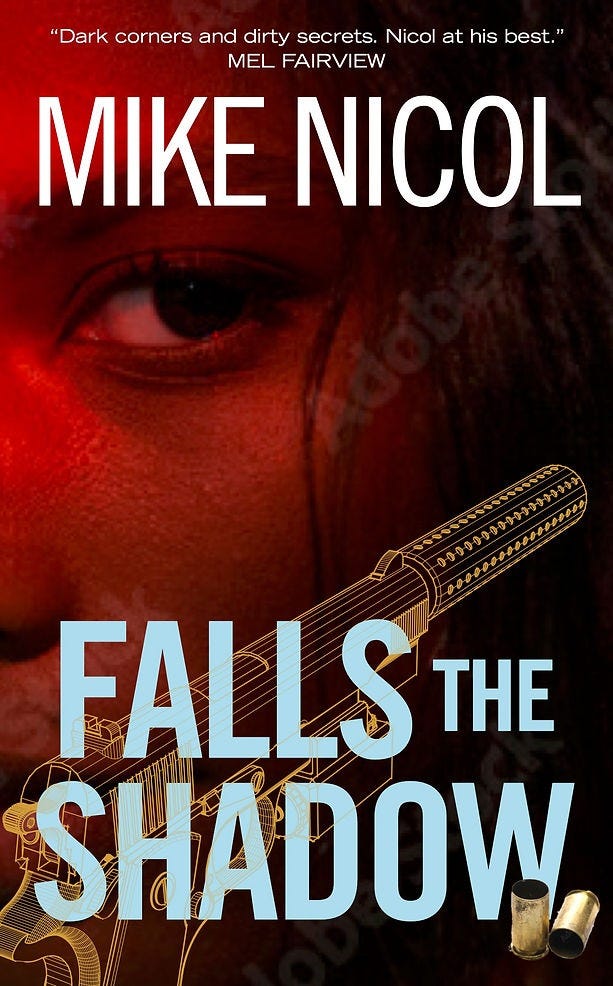
As part of their marketing drive for my novel, Falls the Shadow, Catalyst Press in the US sent through a list of questions. This was something no publisher had done before but then there are many things publishers can do now that they couldn’t in the past thanks to social media. Their man behind the interrogation was Britain Powers.
Britain: What was your main inspiration behind Falls the Shadow?
Mike: A decision to write a cop novel after resisting for many years. The resistance was because I’m of a generation in South Africa who viewed the cops as a fascist force there to police the government’s apartheid regulations. I had to overcome that prejudice and decided the best way to do that was to have a cop who policed the cops.
Britain: You dive into some very hard-hitting material right away in Chapter One, including child homicide at the hands of parents. What was that experience like for you as a writer, emotionally and creatively?
Mike: My fiction has always dealt with the violent side of society - a consequence of living in a country at a time when violence was - and still is - everywhere. Which is not to say that I am immune emotionally, it’s just to say that if I am going to write about the society I live in I have to face the daily horror. We have a high murder rate, often higher than countries at war. We have high rates of attacks on women and children. I can’t live here and ignore these things.
Britain: I found it interesting that you chose to provide perspectives from inside the corruption so early on. Usually in mysteries, the “bad guy” perspective is kept in the dark until later in the story. What informed this decision, and how do you think it impacts the reader’s experience?
Mike: I think the concept of mysteries is probably more applicable to US and UK crime fiction. In South Africa the crime novel is a novel about crime. The bad guys are central characters. It’s not about who did the dark deed. It’s about sorting out the consequences of the dark deed. It’s about getting justice. Or not. My hope is that readers are not bothered that there is not a hidden agenda, and that they are reading to find out what the story is and how it ends.
Britain: The dialogue in this novel feels especially insightful in revealing the characters’ motivations and is very realistic. Can you touch on your process for creating believable dialogue?
Mike: When I started writing novels - way back in the 1980s - I was afraid of dialogue. But it’s something novelists have to use, especially in crime novels where the protagonists talk to one another more than in most other genres. Fortunately, I have always been a committed eavesdropper. Wherever I can - in shops, in the street, in restaurants - I listen to other people’s conversations. It’s not for the content but for how they say things. What word order they use. What slang they use. Because I’ve long thought that dialogue is about rhythm. If I can get the rhythm of what is said right, then I can get the character right. In a country with 11 national languages, most people use at least two - plus slang - in ordinary conversation. So it’s important to try and give some indication of this.
Britain: Can you speak about your writing style, particularly your use of short, often incomplete sentences and a matter-of-fact, almost report-like approach?
Mike: My early novels were magical realism and the sentences were long - pages long. With crime fiction I felt there was violence in the story so there should be violence reflected in the sentence structure. In how the sentences look on the page. Hence the short, staccato sentences. But again rhythm is important. When people read they string all those short sentences together in their heads and this should create some sort of verbal music which then moves the story and gives characterisation. At least that’s what I hope. Also the short sentences mean that I have to be canny when it comes to description. No long flowery descriptive passages. Scenes have to be set economically and swiftly but they still have to create a picture in the reader’s imagination. So you give the facts, but it’s how you string the facts together that matters. The wrong word order and the rhythm collapses and you lose the reader.
Britain: Are there any authors or works that influenced the tone, style, or structure of Falls the Shadow?
Mike: This novel is my tenth crime novel so in a sense it is easier to mention the writers who helped me enter the genre. When I started I knew nothing about the genre. I hadn’t read a crime novel since I was sixteen. Anyhow, I began with Wilkie Collins and, obviously, Dashiel Hammett and Raymond Chandler. And went on from there. There are many who really helped me shape sentence structure, style and tone. Interestingly they are mostly American, with the exception of Ken Bruen and John le Carre. The list, in no particular order, is George Pelecanos, James Ellroy, Elmore Leonard, Walter Mosley, Vicki Hendricks, Robert B Parker, Don Winslow, George V Higgins, James Crumley, Megan Abbot, Richard Stark, Richard Price, James Sallis, and then Joan Didion whose Democracy and The Last Thing He Wanted are at the top of the list of fiction I treasure. Also, Scott Fitzgerald’s The Great Gatsby, and I have a fondness for Faulkner - for the music of his prose.
Britain: What was your writing process like? Did you run into any surprises or unexpected challenges?
Mike: I have to admit that for me the writing process is full of constant surprises and challenges but this is probably because I am not a great planner. I might have a vague idea of the story but it is really vague. How it happens is determined by the characters. That sounds as if they have independent volition, obviously they don’t, but equally, quite clearly, they do. The writer ends up following where they lead. The most challenging surprise was what happened late in the first part... To say more would be to give some of the story away. Suffice to mention, it occasioned a moment when I sat back and said, Now what?
Britain: Were there any differences in your writing process for Part One versus Part Two?
Mike: Not so much a difference in the writing process as in thinking about Zara. She is now battling with her conscience, she is grieving, and she is more determined to bring the bad guy to book. So, in a sense, there had to be more drive to the narrative. More compulsion.
Britain: How did you ensure the procedural or investigative elements of the story felt realistic without overwhelming the narrative?
Mike: To be honest the procedural side of the novel played a fairly minor role for me. Of primary importance was the narrative, this happened and because that happened this happened and then this and this followed. The investigative process does spur on the story but I see it more as a helpful device because to me the unfolding of the story is the dominant concern.
Britain: There are many main character deaths throughout the story. Can you speak to what informed your decision not to shy away from killing off main characters, and how you think this choice impacts the novel as a whole?
Mike: It’s almost a policy for me to kill off main characters. Two reasons. The first selfish one is that I want to keep on creating new characters and I don’t want to get trapped into characters who pitch up again and again. Although, I have to confess, that I do have some recurring characters but they are mostly of a minor nature. Second reason is that if no one is sacred, readers never know who is going to be killed. So there should always be the hesitancy: will he do away with this one? I’ve had readers tell me they shed a tear when I killed off a well-liked character. For me that’s a good sign. It means that while those characters were on the page they worked, they were convincingly real. Which is one of the wonderful ambiguities about fiction. It’s not real but it can feel like it.
Britain: Who was your favourite character to write, and why?
Mike: This might sound weird but there wasn’t a favourite - apart from Zara. She was a helluva challenge for all sorts of reasons but most importantly I had to make her believable. She had to be capable of mad things and also of reasoned actions; she had to express love for those dear to her, and empathy for others. She also had to expect the worst from the people she investigated. Her voice was clear, I could hear her distinctly and when she came onto the page she wrote herself. Of the others, the bad ones are the ones I enjoy the most, probably because they just let rip without thought to morality or consequences.
Britain: Did any characters evolve differently than you initially planned?
Mike: As I mentioned earlier I’m not one for planning so I didn’t really have any idea of how the characters would evolve. But there is also a short answer here: yes, one of them “evolved” entirely differently to the way I had thought he would go. I had planned on a cop duo only to have that idea shredded.
Britain: What do you hope is the main takeaway for readers of Falls the Shadow?
Mike: I hope they like Zara and want more of her. I also hope that when they close the book, they think, Ja, that was lekker [enjoyable]. With a bit of luck readers will also get a glimpse into the complexities of modern day South Africa and our history.
Thank you Mike. Loved reading about your own process.
I got totally into the sample on my kindle, my first crim read ever I might add and it was gripping. But then it got too gripping! Missiles started heading for Dubai and I had to retreat into safer rom com territory for a while in the book department! As soon as things settle I’ll be back